

Strategy & Business Alignment for Azure AI Foundry Adoption
Series: Azure AI Foundry Adoption Framework for Enterprise
Audience: Senior Full Stack Developers · Solution Architects · Tech Leads
Introduction
The fastest way to kill an enterprise AI initiative is to start with technology. Pick a model, spin up a project in Azure AI Foundry (now Microsoft Foundry), deploy to production, then discover six months later that no one agreed on what success looks like, the data pipeline was never approved by compliance, and the CFO is asking why token costs tripled without measurable business impact.
This ten-part series exists to prevent that outcome. We begin with strategy, not because it's the exciting part, but because every technical decision in the nine articles that follow depends on getting this layer right.
What Azure AI Foundry Brings to the Table
Azure AI Foundry (rebranded from Azure AI Studio at Ignite 2024, and elevated to Microsoft Foundry at Ignite 2025) serves as Microsoft's unified platform for building, deploying, and managing enterprise AI applications and agents at scale.
Key capabilities that shape your strategy:
| Capability | What It Means for Strategy |
|---|---|
| *11,000+ model catalog | Choose the right model per use case, avoid vendor lock-in |
| Agent Service | Automate business processes with action-oriented AI agents |
| Unified SDK (Python/C#) | Leverage existing developer skills — reduce ramp-up time |
| Built-in governance | Enforce policies at the platform level from day one |
| Provisioned Throughput | Plan capacity and costs for production workloads predictably |
Understanding these capabilities early prevents the common mistake of treating AI Foundry as "just another API endpoint."
Define Your AI Strategy Using the Cloud Adoption Framework
Microsoft's Cloud Adoption Framework prescribes four pillars for an AI strategy. Map each pillar to concrete deliverables before writing any code.
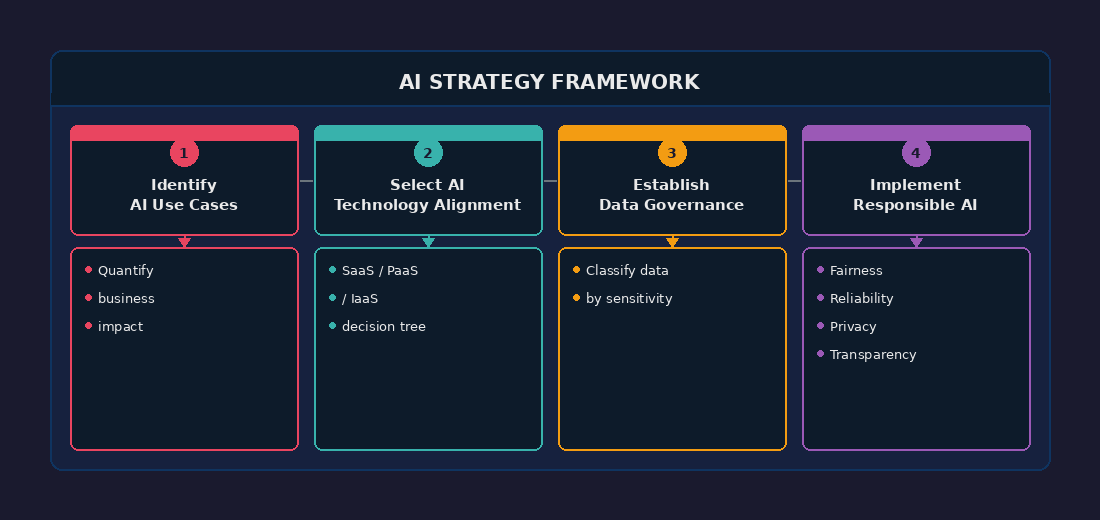
Pillar 1: Identify AI Use Cases
Anchor every use case to a quantified business objective. Evaluate candidates across three dimensions:
- Business Impact: Does it support organizational priorities? Quantify cost reduction, revenue increase, or customer satisfaction gains.
- Technical Feasibility: Can existing infrastructure and team skills support it?
- User Desirability: Will end users adopt it and benefit from it?
For each use case, define a Goal (general purpose), an Objective (desired outcome), and a Success Metric (quantifiable measure). Avoid starting with "we want to use GPT-4o", start with "we want to reduce claims processing time by 40%."
Pillar 2: Select the Right AI Technology
Match the consumption pattern to your use case maturity:
| Pattern | When to Use | Microsoft Solution |
|---|---|---|
| SaaS | Quick deployment, minimal setup | Microsoft 365 Copilot, Role-based Copilots |
| PaaS | Custom development, managed services | Azure AI Foundry (RAG, Agents, Fine-tuning) |
| IaaS | Full control, strict compliance | Azure VMs with GPU, Azure Kubernetes Service |
Most enterprise teams start with PaaS through Azure AI Foundry for custom applications, while consuming SaaS Copilots for productivity. Reserve IaaS for workloads requiring custom runtimes or specialized compliance constraints.
Pillar 3: Establish Data Governance
Classify all data by sensitivity before connecting it to any AI model. Use Microsoft Purview Data Security Posture Management (DSPM) for AI to discover, classify, and protect data across your estate. Define clear policies for:
- Which data sources feed into model grounding
- Who approves new data connections
- How data lineage and provenance get tracked
Pillar 4: Implement Responsible AI
Align with Microsoft's six Responsible AI principles: Fairness, Reliability and Safety, Privacy and Security, Inclusiveness, Transparency, and Accountability. Azure AI Foundry provides built-in content safety filters and evaluation tools, integrate these into your CI/CD pipeline from the start, not as an afterthought.
Build the Business Case: TCO and ROI
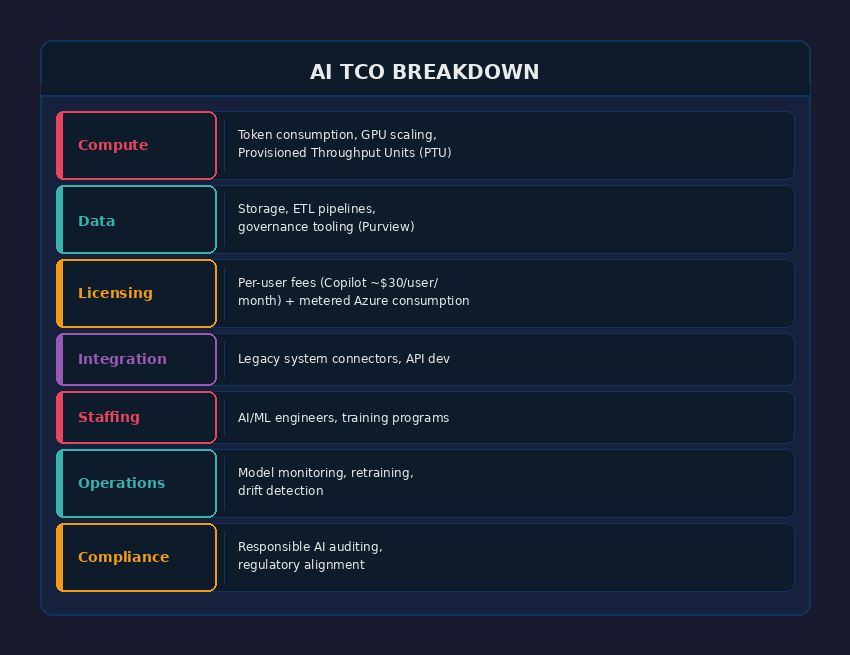
Secure executive sponsorship by presenting a realistic Total Cost of Ownership alongside projected returns.
TCO Components
Pricing Models That Affect Strategy
Azure AI Foundry offers multiple pricing tiers, select the right one based on workload predictability:
| Pricing Model | Savings vs. On-Demand | Best For |
|---|---|---|
| Standard (On-Demand) | Baseline | Experimentation, variable loads |
| Provisioned (Hourly) | Dedicated throughput | Production workloads |
| *PTU Monthly Reservation | Up to 64% | Steady monthly usage |
| PTU Annual Reservation | Up to 70% | Long-term production commitments |
| Batch API | Up to 50% | Bulk processing, non-real-time |
ROI Benchmarks
Use industry data to frame projections for stakeholders:
- A Forrester TEI study projects three-year present value of Azure OpenAI Service between $45.9M and $197.4M depending on deployment scale.
- Organizations report (sponsored by Microsoft) an average of $3.70 in value for every $1 invested in generative AI, with top performers reaching $10 per dollar.
- Specific wins: TAL Insurance deployed Copilot for Microsoft 365, with average users saving 1–2 h/week avg (up to 5–6 for some).
- Separately, TAL built a 'Claims Assist Knowledge Search' using Azure OpenAI Service to streamline claims processing and improve customer query response times."
Present these as benchmarks, not guarantees. Your actual ROI depends on use case selection, data quality, and adoption rates.
Align Stakeholders Across the Organization
Secure cross-functional buy-in early. Map stakeholders to their primary concerns:
| Stakeholder | Primary Concern | Address With |
|---|---|---|
| CTO / VP Engineering | Technical feasibility, security | Architecture review, WAF assessment |
| CFO / Finance | Cost control, ROI timeline | TCO model, pricing tier analysis |
| CISO | Data protection, compliance | Entra ID integration, Defender for Cloud |
| Legal / Compliance | Regulatory alignment, liability | Responsible AI framework, ISO 42001 |
| Business Unit Leads | Time to value, user adoption | Use case prioritization, pilot results |
Azure AI Foundry achieved ISO/IEC 42001:2023 certification (announced July 2025), the first AI management system standard covering risk management, bias mitigation, transparency, and human oversight. Use this certification in conversations with compliance and legal teams.
Key Takeaways
- Start with business outcomes, not model selection. Define measurable goals for every AI use case before choosing technology.
- Use Microsoft's CAF AI Strategy framework to structure your approach across Four core areas: use cases, technology selection, data governance, and responsible AI.
- Build a realistic TCO model that accounts for compute, data, licensing, integration, staffing, operations, and compliance costs.
- Secure stakeholder alignment early by mapping each group's concerns to concrete deliverables and industry benchmarks.
Next challenge is making sure your AI initiatives don’t violate regulations or organizational policies, That's where governance comes in and it's more than just checking compliance boxes. In the next article, we'll build out the governance stack that turns your strategic intent into enforceable guardrails across identity, data, and responsible AI
References
- Create Your AI Strategy — Cloud Adoption Framework
- AI Adoption Overview — Cloud Adoption Framework
- What Is Microsoft Foundry — Microsoft Learn
- Azure AI Foundry: Your AI App and Agent Factory — Azure Blog
- Azure OpenAI Service Pricing
- Provisioned Throughput Concepts — Microsoft Learn
- Forrester TEI Study for Azure OpenAI
- ISO/IEC 42001 Certification — Azure Blog
- Business Plan for AI Agents — Cloud Adoption Framework
- Responsible AI for Microsoft Foundry — Microsoft Learn
- AI Workloads on Azure — Well-Architected Framework